RSO vs CBD Oil – What’s the Difference?

In the world of cannabis-derived products, two names often pop up: Rick Simpson Oil (RSO) and CBD oil. While they may seem similar at first glance, these two oils are quite different in how they’re made, how they’re used, and most importantly, how they make you feel.
RSO is bold, potent, and full of THC, while CBD oil is mellow, versatile, and non-intoxicating. One typically provides deep relaxation, while the other supports daily balance and overall wellness.. Understanding these differences is key to choosing the right one for your needs.
So, what exactly sets them apart? Whether you’re curious about their effects, legality, or best uses, we’re here to break it all down—clearly, simply, and with just a little bit of wit. Let’s dive in!
What Is Rick Simpson Oil (RSO)?
RSO, short for Rick Simpson Oil, is named after Rick Simpson, a Canadian engineer who popularized it after sharing his personal experience with the extract. Unlike traditional cannabis oils, RSO is made with one goal in mind—maximum potency. It’s a full-extract cannabis oil that contains high levels of THC, the compound responsible for the “high” associated with marijuana.
How Is RSO Made?
RSO is typically made by soaking cannabis in a strong solvent, like ethanol, to extract as many cannabinoids and plant compounds as possible. The solvent is then evaporated, leaving behind a thick, tar-like oil packed with full-spectrum cannabinoids, flavonoids, and terpenes. Because of this process, RSO is one of the strongest cannabis extracts available.
What Is RSO Used For?
RSO is commonly used by individuals looking for high-THC products for wellness purposes. However, because of its extreme potency, it’s not something you’d casually add to your morning coffee. People typically take it in small, measured doses—often referred to as the “RSO regimen.”
Key Takeaways:
- High in THC – Unlike CBD oil, RSO is loaded with THC and can be intoxicating.
- Full-extract oil – Contains a broad range of cannabinoids and plant compounds.
- Used in very small doses – Because of its strength, dosing needs to be carefully controlled.
Next, let’s talk about CBD oil and why it’s the more chill, approachable cousin of RSO.
What Is CBD Oil?
If RSO is the heavyweight champion of THC, then CBD oil is the easygoing, approachable contender. CBD (cannabidiol) oil is a cannabis-derived product that’s non-intoxicating, meaning it won’t get you high. Instead, it’s commonly used for relaxation, general wellness, and daily balance.
How Is CBD Oil Made?
CBD oil is extracted from hemp plants, which are naturally low in THC. The most common extraction methods include CO₂ extraction (a clean, solvent-free process) and ethanol extraction. The result is a light, versatile oil that can be used in tinctures, capsules, edibles, and even skincare.
Types of CBD Oil- Full Spectrum, Broad Spectrum, Isolate
CBD oil isn’t one-size-fits-all. There are different types, each with unique characteristics:
- Full-Spectrum CBD: Contains all cannabinoids, including a trace amount of THC (less than 0.3%).
- Broad-Spectrum CBD: Similar to full-spectrum but with the THC removed.
- CBD Isolate: Pure CBD, with no other cannabinoids, THC, or other compounds.
For a comprehensive breakdown of the differences check out this guide from the National Institute of Health
What Is CBD Oil Used For?
CBD oil has become a staple for people looking for a natural way to support relaxation and overall wellness. Many users incorporate it into their daily routines for balance, but unlike RSO, it doesn’t have strong psychoactive effects, so it’s easier to use throughout the day.
Key Takeaways:
- Non-intoxicating – Won’t cause a high like RSO.
- Versatile and widely used – Found in tinctures, edibles, topicals, and more.
- Different formulations – Available in full-spectrum, broad-spectrum, and isolate.
Next, we’ll compare these two oils side by side to see which one best fits your needs!
Key Differences Between RSO and CBD Oil
Now that we know what RSO and CBD oil are, let’s break down the biggest differences:
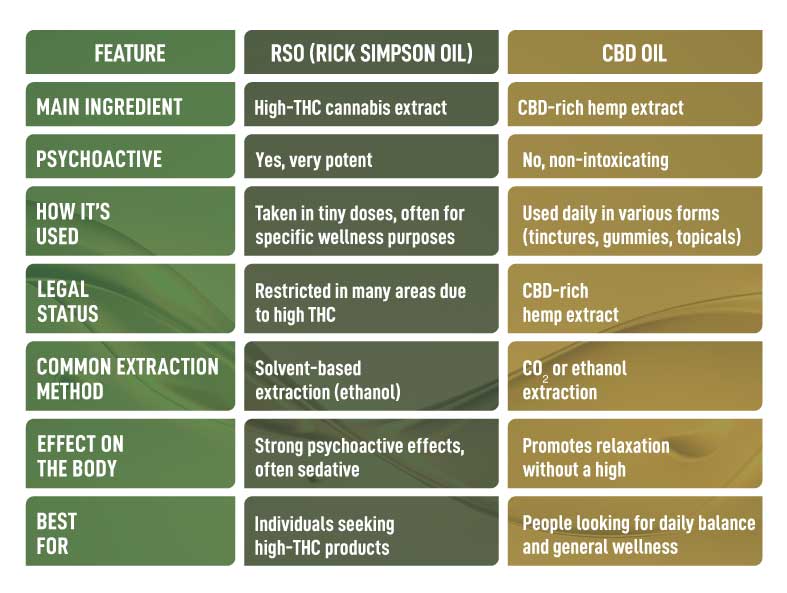
RSO and CBD oil each have their strengths—choosing between them depends on what you’re looking for. Need something strong and THC-heavy? RSO might be your pick. Want something mild, versatile, and non-intoxicating? CBD oil is the way to go.
Next, let’s explore which one might be right for you!
RSO vs CBD: Which Cannabis Product is Best For You?
Now that you know the key differences, how do you decide which one fits your needs? Here are a few things to consider:
Go for RSO if…
- You’re looking for a high-THC product and are comfortable with its effects.
- You need something strong and full-spectrum for specific wellness goals.
- You don’t mind the thick, concentrated oil texture and measured dosing.
Go for CBD Oil if…
- You want a daily wellness product without psychoactive effects.
- You prefer something versatile—tinctures, gummies, topicals, and more.
- You want a legal, easy-to-access product that fits seamlessly into your routine.
At the end of the day choosing between RSO and CBD oil comes down to your wellness goals, comfort with THC, and the desired effects you’re looking for. If you’re unsure, starting with CBD oil is usually the safer and more approachable option. And if you do decide to try RSO, make sure to start low and slow to gauge how it affects you.
Next, let’s wrap it up with a quick recap!
RSO and CBD Oil: The Bottom Line
Both RSO and CBD oil have their place in the cannabis world, but they serve very different purposes. RSO is strong, THC-heavy, and not for the faint of heart, while CBD oil is milder, more versatile, and beginner-friendly.
If you’re looking for something powerful and full-spectrum, RSO might be worth exploring. If you prefer a gentle, non-intoxicating option for everyday use, CBD oil is your go-to. Either way, choosing the right product comes down to understanding your own needs and comfort level.
No matter which you choose, always buy from trusted sources and start with small doses to see how your body responds.
Looking to try a high-quality CBD product? Check out our latest CBD oils and tinctures to find the perfect fit for your routine!