CBD (cannabidiol) has quickly become a staple in many wellness routines, celebrated for its potential to support relaxation, ease stress, and enhance overall well-being. Derived from hemp, this non-psychoactive cannabis compound is federally legal—but navigating the patchwork of state-specific regulations can be tricky.
If you’ve ever wondered “is CBD legal” or searched for answers about what states is CBD illegal, you’re not alone. Laws and restrictions vary widely across the U.S., with some states where CBD is illegal maintaining strict prohibitions while others embrace full legalization. Whether you’re exploring CBD for the first time or simply catching up on the latest updates, this comprehensive guide breaks down everything you need to know about CBD’s legality in 2025.
Understanding CBD: A Brief Overview
CBD (short for cannabidiol) is a natural, non-intoxicating compound primarily extracted from hemp, a variety of cannabis. Unlike THC, CBD won’t leave you feeling “high,” but it does interact with your body’s endocannabinoid system, a network involved in regulating things like mood, sleep patterns, and appetite.
CBD comes in many forms—oils, capsules, gummies, creams, and even beverages. Each product type has its advantages. Many consumers buy CBD capsules for precise dosing, while others prefer the variety offered by edibles. Those seeking the benefits of CBD gummies appreciate their ease of use and discreet consumption. For localized relief, CBD cream legal in most states provides targeted application. Some users even buy CBD vape pens for faster absorption, though vaping regulations vary by state.
While CBD’s popularity continues to soar, it’s not a magic solution, and ongoing research is essential to fully understand its effectiveness. Always opt for reputable brands that prioritize safety, transparency, and quality assurance.
Whether you’re seeking help with stress relief, better sleep, or simply curious about wellness options, staying informed about CBD’s possibilities and limitations will help you make smarter, safer decisions.
Is CBD Legal at the Federal Level?
The 2018 Farm Bill made hemp-derived CBD federally legal in the United States, as long as products contain less than 0.3% THC. However, a common question remains: can CBD products contain any THC, and is that legal? The answer is yes—hemp-derived CBD can legally contain trace amounts of THC (up to 0.3%), though this small amount isn’t enough to cause psychoactive effects.
Each state retains the authority to set its own CBD regulations, causing significant variations nationwide. As of 2025, many states, along with Washington, D.C., have legalized cannabis either medically, recreationally, or both, directly impacting CBD’s availability. Other states have introduced tighter restrictions, allowing only limited CBD use or imposing strict THC thresholds.
The FDA complicates matters further, having approved only one pharmaceutical CBD product—Epidiolex, prescribed exclusively for rare forms of epilepsy. General CBD products intended as dietary supplements or food additives have yet to receive FDA approval, leaving them in regulatory limbo. Although enforcement remains minimal, this ambiguity makes careful state-by-state verification critical before buying or using CBD.
CBD Laws by State: Updated for 2025
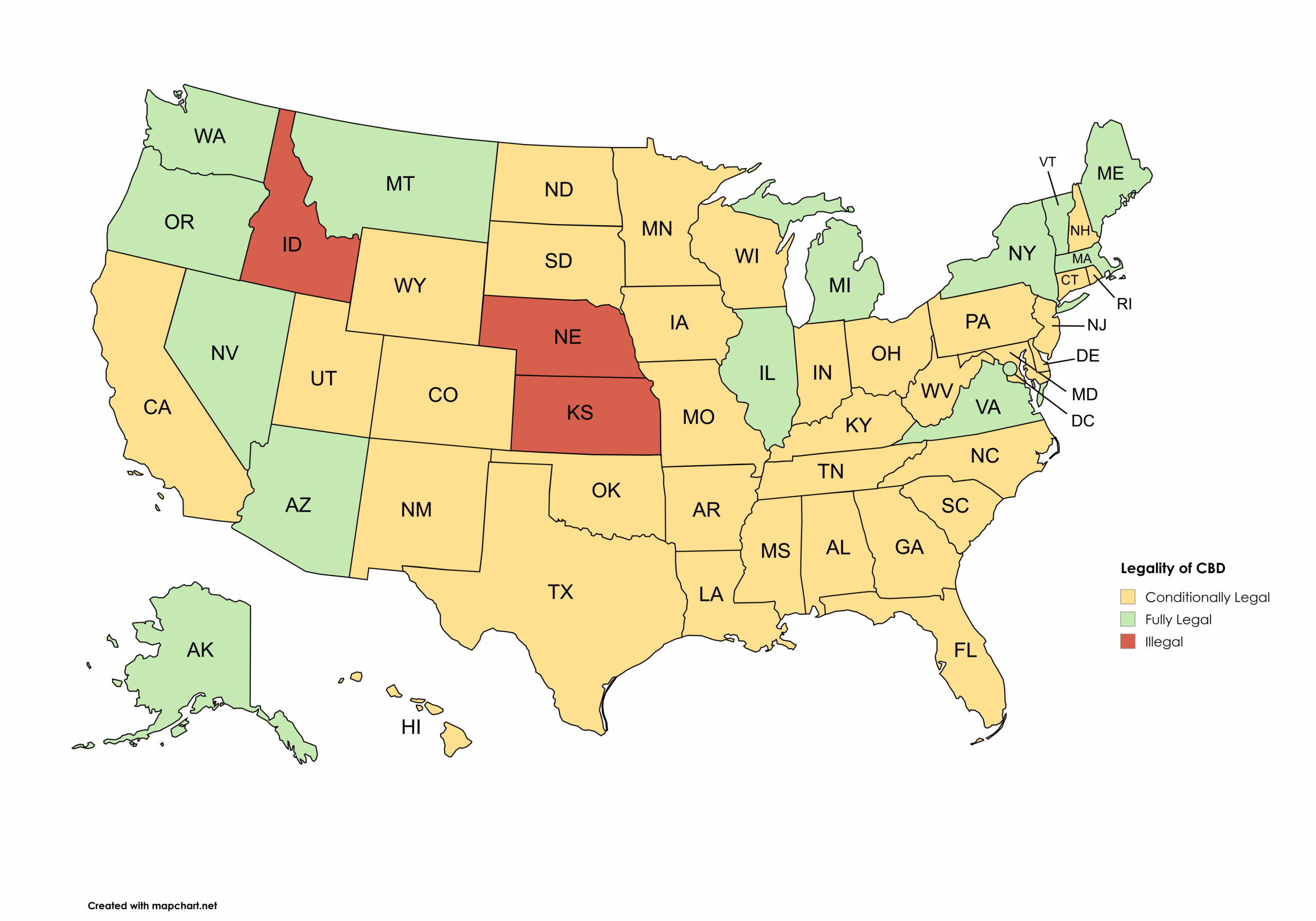
To help navigate state-specific regulations, here is the updated breakdown of CBD legality in each state:(Table updated March 25, 2025)
State Spotlight: Texas, California, and Georgia Tighten CBD and THC Regulations
As CBD and hemp-derived products continue to grow in popularity, several states have enacted significant legislative changes to regulate their sale and use. Texas, California, and Georgia have each introduced measures that reshape the legal landscape for CBD and THC products.
Texas: Senate Bill 3 Targets THC Products
In March 2025, the Texas Senate passed Senate Bill 3, significantly restricting retail sales of THC products, including Delta-8, Delta-9, and THC-infused beverages. This affects questions about batch CBD Delta 8 legal status in Texas. The bill aims to restrict consumable hemp products to non-intoxicating cannabinoids like CBD and CBG.
California: Legal Battles Over Hemp-Derived Products
California has recently intensified regulations on hemp-derived products. In September 2024, California enacted emergency regulations prohibiting the sale of hemp products containing detectable levels of intoxicating cannabinoids and imposing age restrictions.
Georgia: New Regulations on Hemp Products
Georgia has introduced new laws to regulate its growing hemp industry, affecting products like CBD gummies and beverages. These new regulations include setting a legal consumption age of 21, establishing testing and registration protocols, and limiting the amount of Delta-9 THC in products.
Traveling with CBD: What You Need To Know
Always check state laws before traveling domestically with CBD, as regulations can differ significantly. Even federally legal CBD products may encounter restrictions or prohibitions in certain states.
The TSA allows hemp-derived CBD products containing less than 0.3% THC in carry-on and checked bags. However, TSA agents may refer the matter to local law enforcement if questions arise, making it crucial to:
- Carry products with clear labeling showing THC content
- Keep CBD in original packaging
- Have lab reports available if possible
- Research destination state laws thoroughly
International travel with CBD products is generally discouraged unless specifically confirmed legal in your destination. Some countries have strict anti-cannabis laws, and even minimal amounts of CBD could lead to severe legal consequences abroad. (TSA Guidelines)
CBD’s Future: What’s Next for Legalization
While many anticipate broader CBD legalization, opposition and regulatory complexities remain prominent. Recently, anti-legalization groups have intensified efforts to influence policy and public perception, potentially slowing cannabis reform. According to Reuters, these groups argue against legalization citing health and safety concerns, complicating the push for more uniform federal legislation (Reuters).
Federal action remains the most crucial factor in determining future CBD regulations. The FDA emphasizes ongoing regulatory uncertainty regarding CBD’s approval as a dietary supplement or food additive, highlighting the need for clearer guidelines and enforcement consistency (FDA).
As states continue to navigate the complexities of batch CBD “is Delta 8 legal: navigating the world of Delta-8 THC” and similar cannabinoid questions, the landscape remains dynamic. Legislative efforts, such as comprehensive cannabis reform by Congress, could further stabilize the market and enhance consumer safety.
Choosing CBD Wisely: Staying Safe & Compliant
Understanding CBD’s legal landscape is essential. Because regulations can shift at any time, stay on top of your state’s rules, choose a reputable brand, and consult a healthcare professional for personalized guidance.
When shopping for CBD:
- Verify third-party lab testing
- Check THC content documentation
- Confirm state-specific compliance
- Research brand reputation and transparency
- Consider starting with lower potencies before trying stronger options like 1000 mg formulations
At Extract Labs, we’re committed to transparency and compliance—whether you’re exploring our full spectrum oils, tasty gummies, soothing topicals, or convenient capsules. Visit our store to shop our rigorously tested CBD products and enjoy peace of mind with every purchase.
CBD is legal at the federal level; however, its legality can vary by state.
CBD is currently fully legal in 10 states. Idaho, Nebraska, and South Dakota have the most strict policies on CBD, making it illegal, even for medical use. Check out our chart with all 50 states.
It's usually okay to travel with hemp-derived CBD domestically. The TSA permits products with less than 0.3% THC, but always check destination state regulations.
While more research is being conducted on potential benefits and risks, and more states move to legalize medical and recreational cannabis, the legal status of CBD will likely continue evolving.
No, some states like Idaho and Kansas prohibit all CBD regardless of THC content, while others have specific restrictions even for hemp-derived products.
In Texas, CBD is legal with less than 0.3% THC. However, the House Bill 1325 made it so CBD products must be tested and labeled accurately, and retailers must be liscenced by the state. As well, CBD is for medical use only.
Works Cited
Business of Cannabis. “Texas Senate Approves Controversial Ban on THC.” March 2025. https://businessofcannabis.com/texas-senate-approves-controversial-blanket-ban-on-thc/.
Reuters. “Hemp Legal Fights Heat Up in California.” October 2024. https://www.reuters.com/legal/government/column-hemp-legal-fights-heat-up-california-beyond-2024-10-09/.
Axios Atlanta. “Georgia Tightens Regulations on Hemp Products.” 2025. https://www.axios.com/newsletters/axios-atlanta-b8be9240-63a7-11ef-8ff4-b1aca0276d34.
- FDA. “FDA Regulation of Cannabis and Cannabis-Derived Products, Including Cannabidiol (CBD).” U.S. Food & Drug Administration, 2024, https://www.fda.gov/news-events/public-health-focus/fda-regulation-cannabis-and-cannabis-derived-products-including-cannabidiol-cbd
- Reuters. “Cannabis legalization pushback: Anti-legalization groups ramp up efforts to stop the green wave.” 2025. https://www.reuters.com/legal/litigation/cannabis-legalization-pushback-anti-legalization-groups-ramp-up-efforts-stop-2025-03-19/.